

One of the most persistent fears families carry into a bereavement is that the bills are now theirs. They are not. Debt when you die is paid from your estate, in an order set by state law, and if the estate cannot cover everything the remainder is generally written off. Nobody inherits a balance simply by being related to you.
That reassurance matters, because believing the opposite about debt when you die costs families real money. Families routinely pay bills out of their own accounts, out of grief, guilt, or pressure from a persistent caller — and once paid, that money is almost never coming back. Here is who is actually liable, which debts survive, and what to say when the phone rings.
1. Debt when you die is paid by the estate, not the family
Debt when you die does not disappear, but nor does it transfer: assets and liabilities form an estate. The executor gathers what there is, works through the debts in legal priority order, and distributes whatever remains. If the debts exceed the assets the estate is insolvent, and unsecured creditors take the loss. The FTC’s guidance on debts and deceased relatives states the position plainly and is worth having open during any difficult call.
2. When a relative genuinely is liable
There are real exceptions to the rule on debt when you die, and they all pre-date the death. You are liable if you co-signed the loan, if it was a joint account rather than an authorised-user card, or in some community property states if you were married when the debt was incurred. A few states also have filial responsibility statutes covering certain care costs. Being an executor, by contrast, does not make you personally liable for anything — provided you administer the estate properly.
3. Secured debts follow the asset
Secured debt when you die does not vanish, and a mortgage is the clearest example. Whoever inherits the house inherits the obligation to keep paying, or the lender eventually forecloses. The same applies to a car loan. Families sometimes stop paying a mortgage during probate on the assumption that everything is frozen, and lose equity that way — if someone intends to keep the property, the payments need to continue.
4. Which debts get paid first
The order in which debt when you die gets paid is set by statute, and it is not first-come-first-served. Funeral expenses, the costs of administering the estate, and taxes typically rank ahead of unsecured debts such as credit cards. This is precisely why an executor should pay nothing until the full picture is clear: settling a loud credit-card claim early, then discovering a higher-priority tax liability, can leave the executor personally on the hook for the difference. Our guide to choosing an executor covers that fiduciary exposure, and the CFPB’s guide to managing someone else’s money sets out the duties in more detail.
5. Taxes are still due
Tax is the one form of debt when you die that never simply lapses. A final income tax return covering the year of death is required, and depending on the size of the estate there may be an estate return as well. Tax claims sit high in the priority order and do not disappear with the person. The IRS page for a deceased person sets out which filings apply.
6. What to say to a collector
Collectors chasing debt when you die may contact relatives to locate the executor. They are not permitted to imply you are personally responsible when you are not, and they may not harass you. Keep it short: you are not liable, the estate is being administered, submit the claim to the estate in writing.
Then log the call — who rang, when, what they claimed, and any reference number. a bill and creditor log makes that trivial and turns a stressful blur into a record you can point at. Critically, do not make a small payment to be helpful; in some circumstances a partial payment can be argued to restart a limitation period on a debt that was already unenforceable.

7. Notify creditors properly, then wait
Part of settling debt when you die is formally notifying creditors and giving them a statutory window to come forward. That waiting period is a feature, not a delay to be worked around: it draws out claims so the estate can be settled once, cleanly. Our list of who to notify when someone dies covers the notifications that run alongside, and what is probate explains why the timeline looks the way it does.
What you can do now, while planning
The kindest thing you can leave on the subject of debt when you die is a written list of what you owe and to whom. Families frequently overpay simply because they cannot tell a genuine creditor from an opportunistic one, and they have no way to know whether a demand relates to a real account.
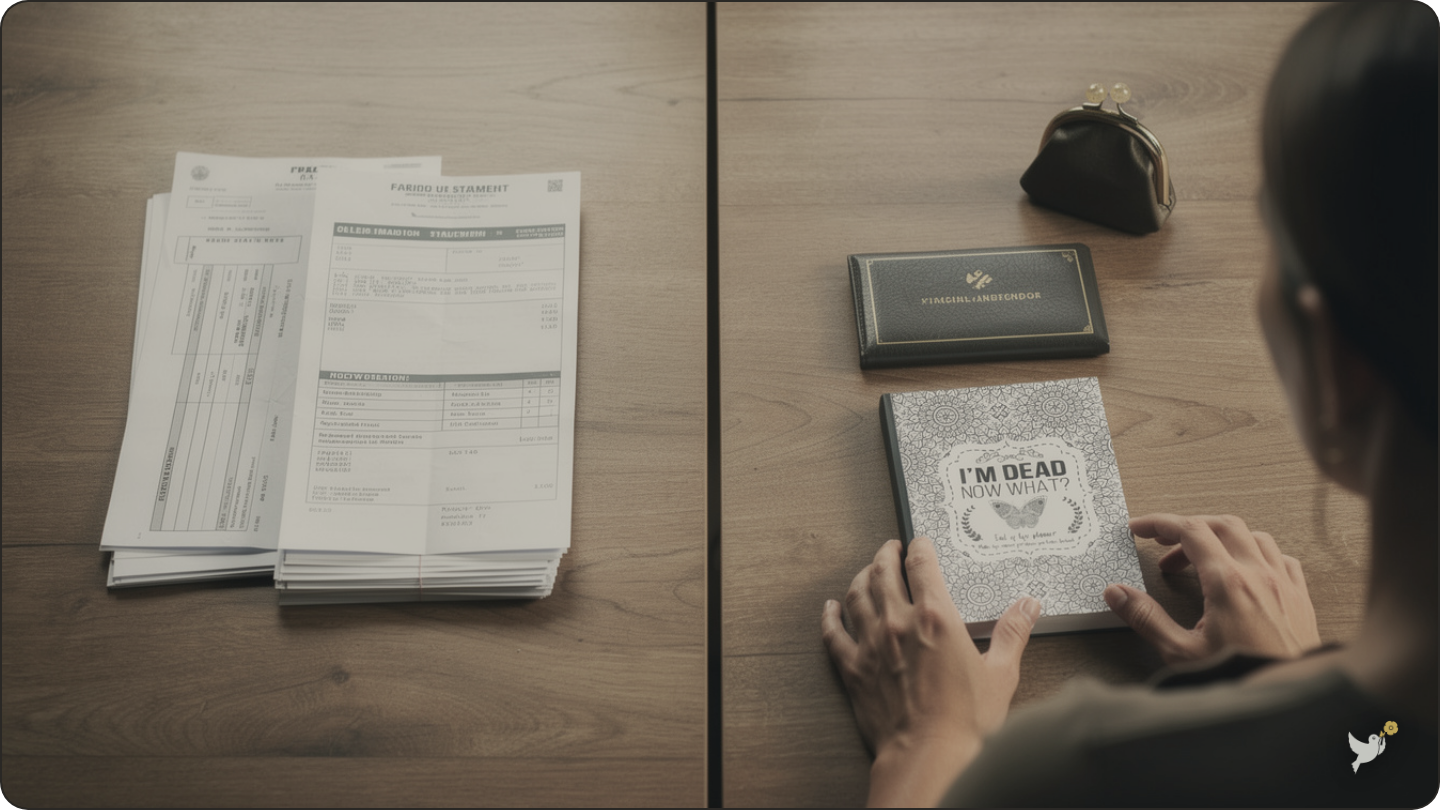
Write down each debt, the lender, the approximate balance, and whether anything is jointly held or co-signed — that last detail is the one that determines whether a survivor is liable at all. Keep it with the rest of the paperwork in a lockable document box, and record it somewhere your executor will actually look; a guided workbook such as the I’m Dead, Now What? planner keeps that list beside the account list and the professional contacts.

The mistake that costs the most
Paying debt when you die from the wrong pocket. Once a relative settles an estate debt with personal money, recovering it means claiming against the estate like any other creditor — assuming there is anything left. Open an estate account, pay everything from there, and keep the two entirely separate from the first week. If money is tight and the picture is unclear, the correct action is almost always to wait rather than to pay.
One further protection is worth knowing about. Because a deceased person’s details circulate widely after a death notice, opportunistic claims do appear — invoices for goods never ordered, or genuine-looking demands for accounts that were settled years ago. An executor is entitled to ask any creditor for documentary proof of the debt before paying it, and should. Requesting verification in writing costs a stamp and filters out a surprising amount.
Finally, if the estate is clearly insolvent, say so early and take advice before paying anyone. An executor administering an insolvent estate has to distribute what little exists strictly by statutory priority, and getting that order wrong is one of the few ways the role becomes personally expensive. Creditors are used to shortfalls; courts are far less forgiving about an executor who paid the loudest claim first.
The short version
Debt when you die is the estate’s problem, not your family’s, unless they co-signed or held the account jointly. Secured debts follow the asset. Taxes and funeral costs outrank credit cards. Collectors may ask questions but may not imply liability that does not exist. And the single most useful thing you can leave behind is a written list of what is owed — so nobody pays a bill that was never theirs.
Frequently asked questions
Do my children inherit my debt when I die?
No. Debt is not inherited. It is paid from your estate — the money and property you leave — and if the estate cannot cover it, the remaining balance is generally written off. Relatives are only liable where they were already legally responsible, such as a co-signer or a joint account holder.
Is a spouse responsible for their partner’s debts?
Sometimes. A spouse is liable for jointly held debt and for anything they co-signed. In community property states a surviving spouse may also be responsible for debts incurred during the marriage. Because the rules vary considerably by state, this is one worth checking locally rather than assuming either way.
Which debts get paid first?
State law sets an order of priority. Funeral and administration costs and taxes typically rank ahead of unsecured debts like credit cards. An executor who pays a persistent credit-card collector before a higher-priority claim can be held personally liable for the shortfall, which is why paying nothing until the picture is clear is the safe approach.
What should I say to a debt collector?
That you are not personally liable, that the estate is being administered, and that they should submit their claim to the estate in writing. Take their details, log the call, and do not agree to pay anything from your own money or make a small “goodwill” payment — in some circumstances that can be argued to revive an otherwise unenforceable debt.
If you’d like a ready-made place to gather everything above, the I’m Dead, Now What? planner keeps it together in one guided book.
This article is for general informational purposes only and is not legal, financial, tax, or medical advice. Rules vary by state and change over time; please consult a qualified professional about your specific situation.