
Of everything that follows a death, clearing out a house is the task families dread most — and the one they most often begin too early. It is physically exhausting, emotionally ambushing, and largely irreversible. A charity bag handed over in week two cannot be retrieved in month three when somebody asks about their mother’s letters.
There is a sensible order to clearing out a house. This guide sets out what to do in the first days, what must never be discarded, when to actually start, and how to divide belongings without opening a rift that outlasts the estate. If you are at the beginning of everything, our guide on what to do when someone dies covers the wider sequence.
1. Secure the house first — do not sort anything
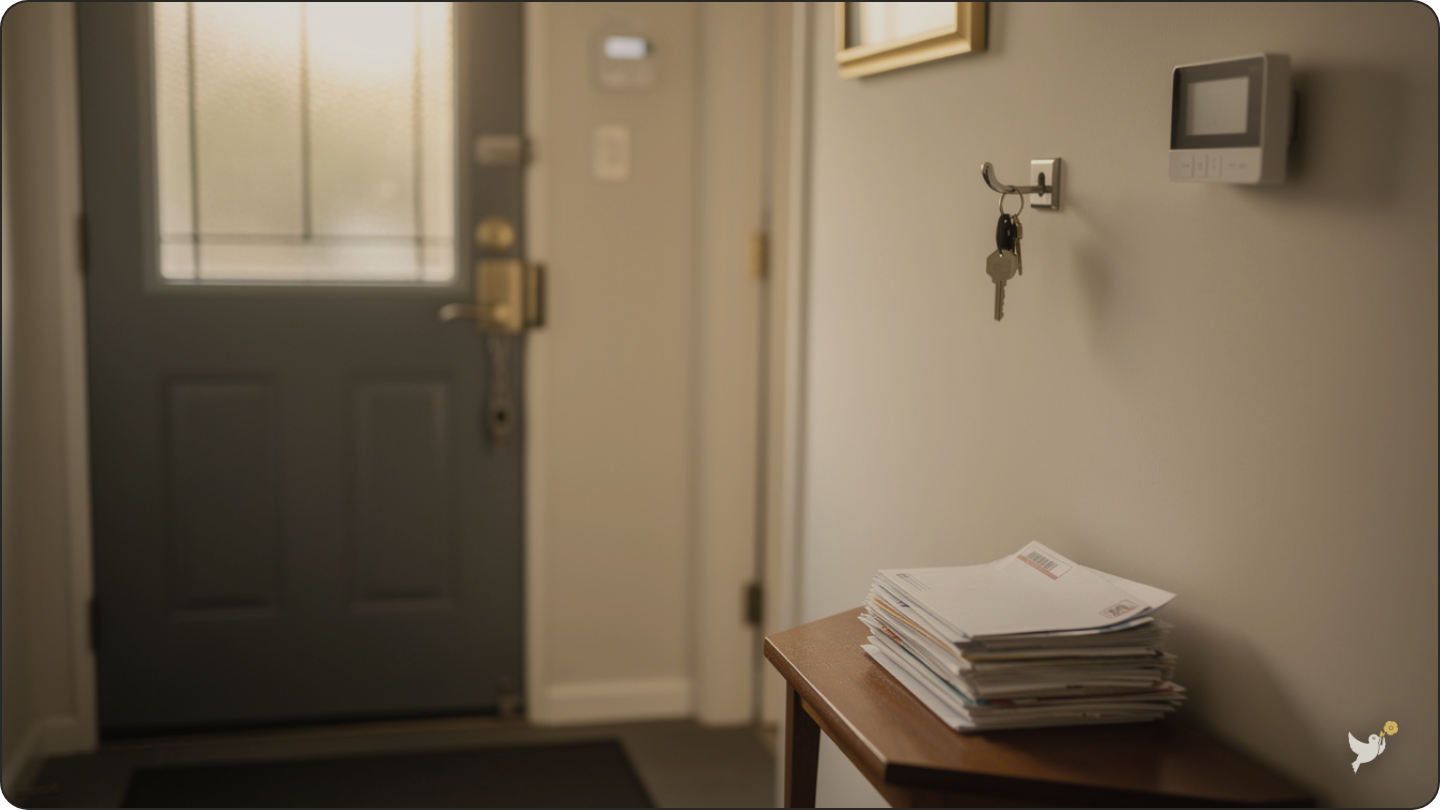
In the first days, clearing out a house is not the job at all — protection is. Lock up and account for every key. Keep the heating on through winter so pipes do not burst, and check that the buildings insurance is still valid — many policies restrict cover once a property is unoccupied, and some require notification within thirty days. Cancel milk and newspaper deliveries.
Deal with the post immediately. An accumulating pile at the door advertises an empty house, and unopened mail is where you discover accounts, policies, and subscriptions nobody knew about. The USPS process for mail for the deceased lets you redirect it, and doing so early also reduces identity-theft risk — the FTC’s guidance on identity theft and online security explains why a deceased person’s details are a target.
2. Wait longer than you want before clearing out a house
Unless a tenancy is ending or the mortgage cannot be covered, there is no urgency about clearing out a house. Grief pushes people to one of two extremes — freezing entirely, or purging the house in a weekend to make the feeling stop. The second causes lasting damage.
Six to eight weeks before serious sorting is reasonable. Executors sometimes feel pressure from beneficiaries to move faster; the honest answer is that clearing out a house before probate authority exists creates more problems than it solves.
3. Find the paperwork before anything else moves
This is the one stage of clearing out a house that genuinely cannot be skipped. Go through every drawer, cupboard, file, and box looking only for documents and valuables. Nothing leaves the house until this is done.
You are looking for the will, deeds, share certificates, savings bonds, insurance policies, pension paperwork, tax records, military discharge papers, and vehicle titles. Also unmarked keys, which frequently open a safe-deposit box or a storage unit the family knew nothing about. And check the unlikely places — cash, jewellery, and bonds turn up inside books, coat pockets, freezer drawers, and biscuit tins with genuine regularity.
Put everything you find straight into one protected container. A fireproof document bag keeps it together and out of the general clearing chaos, which matters when several relatives are working in different rooms.

4. Understand what you are allowed to remove
Until the executor is formally appointed, the estate’s property is not anyone’s to give away. Low-value personal effects are handled pragmatically in practice, but removing anything of real worth before authority exists is the most common trigger both for family disputes and for later claims against the executor personally.
Our guide to choosing an executor covers that exposure, and what is probate explains why the authority takes weeks to arrive. If in doubt, photograph the item, leave it in place, and record it.
5. Work one room at a time, with four destinations
Clearing out a house collapses into chaos when people roam. Clearing out a house works one room at a time: pick one, finish it, and stop. Within each room, everything goes to one of four places: keep, family to decide, sell or donate, or dispose.
The “family to decide” pile is the important one — it is the safety valve that stops a difficult item becoming a decision made alone under pressure. colour-coded sorting labels make the categories visible at a glance, and heavy-duty packing boxes save a lot of swearing, because supermarket boxes fail under books.
6. Divide belongings with a boring, visible system
When families fall out over clearing out a house, sentimental items cause it, not valuable ones. Two people wanting the same worthless mug is a genuinely common scenario, and goodwill alone does not survive it.
Use a rotation: relatives take turns choosing one item each, in a fixed order, and every claimed item is marked with a coloured sticker and written down. Handle anything genuinely valuable separately with a proper valuation, because dividing it by eye invites a challenge later. Where someone cannot attend, let them nominate by video call or send a proxy list — clearing out a house in a relative’s absence, without a record, is how long grudges start.

7. Be realistic about what things are worth
Anyone clearing out a house routinely overestimates furniture and china and underestimate tools, jewellery, records, and anything mid-century. Brown furniture, formal dinner services, and figurine collections have very little resale value now, however much they cost originally. That is worth knowing before anybody spends three weekends trying to sell a dining suite.
Get a house-clearance quote and an estate-sale quote before committing either way. For genuinely valuable single items, a specialist auction house will usually outperform a general clearance by a wide margin — but ask them first rather than after the skip has gone.
8. Protect yourself while you do it
Clearing out a house is physical work, often in dust, sometimes with old chemicals or asbestos in a garage. Clearing out a house safely means gloves, masks, and more time than you planned. Do it with company rather than alone — not for the labour, but because the moment that catches you off guard is easier with someone in the room.
And stop when you have had enough. The house will still be there next weekend. The federal overview of dealing with the death of a loved one gives a sense of everything else running in parallel, and there is no prize for finishing quickly.
What makes this easier for the next family
If you are reading this while planning rather than clearing out a house, the lesson is blunt: the volume is the problem. Every unlabelled box and every drawer of mixed paperwork becomes hours of somebody else’s grief-stricken guesswork.
Two things genuinely help. Keep the important documents in one findable place, so nobody has to search the whole house to be sure. And write down which few items actually matter and who should have them — a short list settles more than a formal valuation ever will. A guided workbook such as the I’m Dead, Now What? planner holds both, alongside where the deeds and keys are kept.
The short version
Secure the house and redirect the mail first. Wait six to eight weeks before real sorting. Find every document and unmarked key before anything leaves. Work one room at a time into four piles, divide by visible rotation with a written record, get quotes before assuming anything is valuable, and stop before you are exhausted. Clearing out a house cannot be made pleasant — but it can be made orderly, and that is most of the difference.
Frequently asked questions
How soon should we clear out the house?
Later than most families think. Unless a tenancy is ending or the mortgage genuinely cannot be covered, there is no need to start within weeks. Grief makes people either freeze or purge, and purging is the one that produces irreversible regret. Six to eight weeks before the real sorting begins is entirely reasonable.
What should never be thrown away?
Anything paper until it has been read. Deeds, share certificates, savings bonds, insurance policies, tax records, military discharge papers, and handwritten letters. Also unmarked keys, which often open a safe-deposit box or a storage unit nobody knew existed. Check inside books, coat pockets, and tins — cash and jewellery routinely turn up there.
Can we start removing things before probate?
Be careful. Until the executor is formally appointed, the estate’s property is not anyone’s to distribute, and removing valuable items early is the single most common trigger for family disputes and for later claims against the executor. Personal effects of little value are usually handled pragmatically; anything of real worth should wait for authority and a written record.
How do we divide belongings without falling out?
Use a dull, transparent system rather than relying on goodwill. Take turns choosing in a fixed rotation, mark each claimed item with a coloured sticker, and write down who took what. Deal with anything genuinely valuable separately, with a proper valuation. Most rifts start with an item taken quietly rather than with a disagreement about who deserved it.
If you’d like a ready-made place to gather everything above, the I’m Dead, Now What? planner keeps it together in one guided book.
This article is for general informational purposes only and is not legal, financial, tax, or medical advice. Rules vary by state and change over time; please consult a qualified professional about your specific situation.