

Almost nothing can be settled after a death without one document: the death certificate. Banks will not release funds without it, insurers will not pay a claim, pension providers will not switch over survivor benefits, and property cannot change hands. It is the single key that unlocks everything else, which is why the first practical question families ask is how many certified copies they need.
The short answer is more than you think. This guide covers how many to order, who insists on an original, what they cost, how to get more if you run short, and how to store the spares so they are still findable a year from now. If you are at the very beginning of all this, our guide on what to do when someone dies sets out the wider order of events.
Why a death certificate matters so much
A death certificate is the legal proof that a person has died. Until an institution has seen one, its records still show a living customer, and it is neither willing nor permitted to act. That is not obstruction; it is fraud prevention, and it protects your family as much as it frustrates them. The federal guide to getting a death certificate explains who issues them and how the process works in your state.
Certified copy or photocopy — the distinction that catches people out
This is where families most often lose a week. A certified death certificate is printed by the vital-records office on security paper, carries a raised or embossed seal, and is signed by a registrar. A photocopy of that document, however clear, has no legal weight whatsoever. Most institutions want a certified original in hand, and a significant number of them keep it and never send it back. That single fact is why ten copies is a starting point rather than an extravagance.

How many copies to order
Count the institutions rather than guessing at a number. Work through: each bank and credit union, each investment or brokerage account, each life-insurance policy, each pension or retirement plan, the Social Security Administration, the motor-vehicle department, any property deed or vehicle title, the probate court, and the final tax filing. Add two or three spares. For most families that arithmetic lands somewhere between ten and fifteen death certificate copies, and it is worth doing the count on paper rather than estimating — the list is almost always longer than the number people first say. Our list of who to notify when someone dies doubles neatly as a counting sheet, and the federal list of agencies to notify when someone dies catches the government offices people forget.
Where the copies actually go
Not every organisation keeps one. Some will glance at the certified copy, take a photocopy for their own file, and hand yours straight back — many banks work this way if you present it in a branch. Others, particularly life insurers and pension administrators, require an original for their permanent records and will not return it. You cannot reliably predict which is which, so plan on the assumption that every death certificate you hand over is gone for good, and be pleasantly surprised when one comes back. Asking at the counter whether they intend to keep it costs nothing and occasionally saves a copy.

What a death certificate costs and how to order more
Fees are set locally and generally run from about $10 to $30 for the first certified copy, with extra copies ordered in the same batch usually costing less each. At the start, the funeral home almost always orders them for you, which is by far the easiest route while everything else is happening. Later on, you order directly from the state or county vital-records office, which is cheaper per copy but slower and requires proof of your identity and your relationship or role.
Running short is common and is not a disaster — it simply costs time. Order the second batch the moment you realise you are down to your last two or three, because processing can take days or weeks depending on the office and the season.
Who is allowed to request one
Most states restrict certified copies to immediate family, the executor or personal representative, and anyone who can demonstrate a direct legal or financial interest. You will usually need government-issued identification of your own, and if you are acting as executor, documentation showing it — the letters testamentary from the probate court, or the will naming you. Keep a scan of that authorisation on your phone; you will be asked for it more than once.
Practical habits that save weeks
Three habits make the whole process smoother. First, keep a written tally: which institution took a certified copy, on what date, and whether they returned it. Without a tally you will lose track by the second week, and duplicate requests waste both copies and calls. an estate and executor organizer is designed for exactly this kind of running record.
Second, carry them properly. Certified copies are stiff, embossed, and easily creased, and a folded or damaged certificate can be rejected. an expanding document wallet keeps them flat and sorted alongside the identification you will be asked for.
Third, never hand over your last one. Keep a final certified copy back for yourself no matter how insistent the request, because the tax filing and any late-surfacing account will need it months after you thought the work was finished. The IRS page for a deceased person sets out the filings that continue into the following year.
Storing the spares
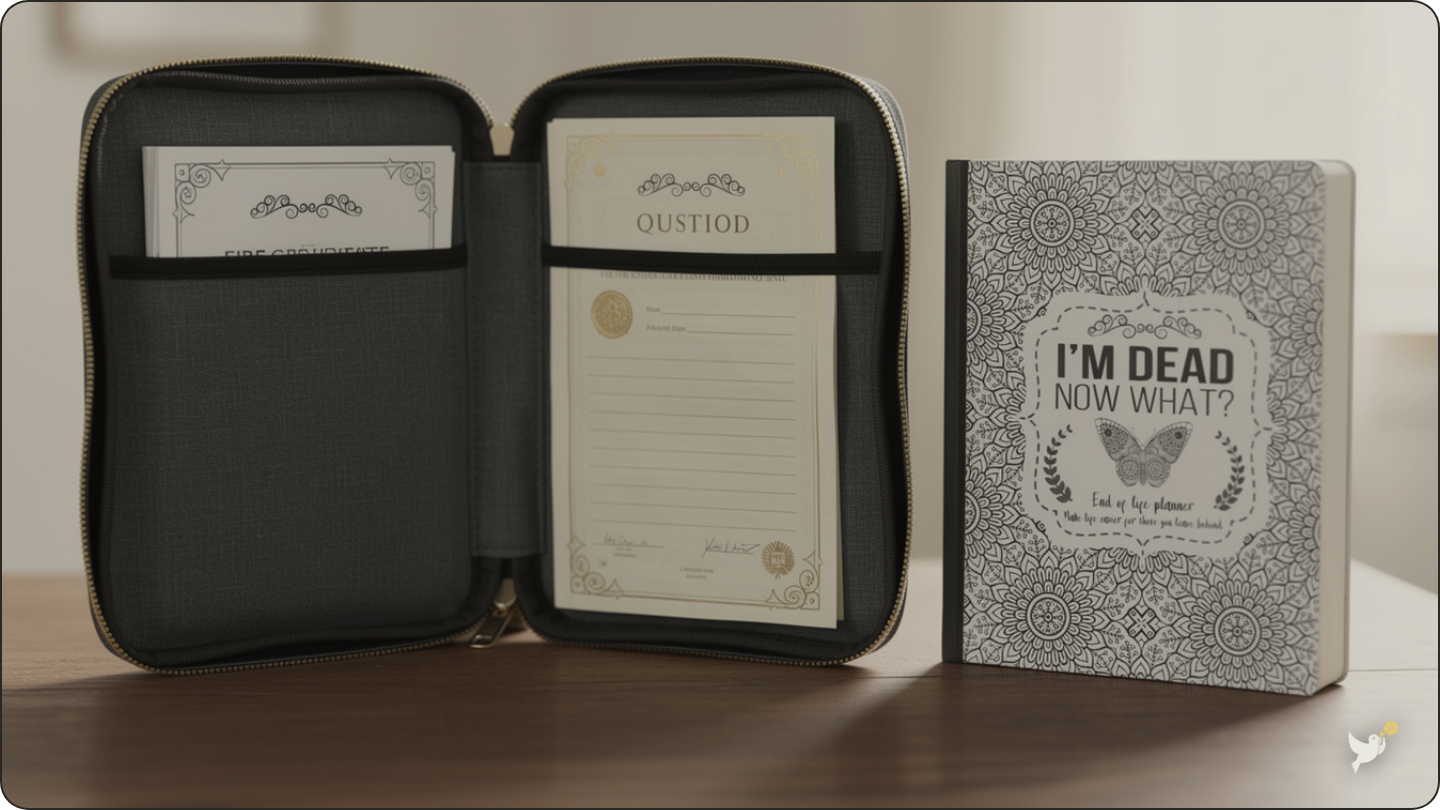
Once the first wave of notifications is done, the remaining certificates belong with the rest of the estate paperwork rather than loose in a drawer. A fireproof document bag keeps them flat, dry, and together with the will, the deeds, and the policies. Our guide on how to organize important documents covers the wider filing question, and the same system works whether you are storing your own papers or administering someone else’s estate.
What this looks like from the other side
If you are reading this while planning ahead rather than administering an estate, there is one thing worth doing. Your family will need to know where your documents are before they can order anything at all — the funeral home will ask for details from your birth record, your Social Security number, and your parents’ names, and a grieving relative should not be reconstructing that from memory. Writing those details down once, in a guided workbook such as the I’m Dead, Now What? planner, removes an early and entirely avoidable obstacle.
It is a small thing that produces a disproportionate amount of relief. The family who knows exactly where to look orders the right number of certified copies in the first week and moves on. The family who does not spends that week on hold, guessing at dates, and waiting for a document that every other task depends on.
The short version
Order ten to fifteen certified copies at the outset, assume each institution keeps the one you give it, keep a written tally of where they went, never surrender your last one, and store the spares flat with the rest of the estate papers. Get that right in the first week and the death certificate stops being an obstacle and becomes what it should be — a piece of paperwork you simply have enough of. Almost every delay families run into in the first month traces back to a missing death certificate rather than to anything genuinely complicated, which makes over-ordering at the outset one of the cheapest good decisions available to you.
Frequently asked questions
How many death certificate copies should I order?
Most families need between 10 and 15 certified copies. Count one for each bank, insurer, pension or retirement provider, property or vehicle title, and government agency involved, then add a few spares. Ordering extra at the outset costs a few dollars each; ordering more later costs another round of forms, fees, and waiting.
What is the difference between a certified copy and a photocopy?
A certified copy is issued by the vital-records office on security paper, usually with a raised or embossed seal and a registrar’s signature. A photocopy has no legal standing. Banks, insurers, and courts almost always require a certified original, and many keep it rather than returning it, which is why families run short.
How much does a death certificate cost?
Fees are set by each state or county and typically run from about $10 to $30 for the first certified copy, with additional copies ordered at the same time often cheaper. Ordering through the funeral home is usually simplest at first; ordering directly from the vital-records office later is normally cheaper per copy.
Who can request a death certificate?
Access is restricted in most states to immediate family, the executor or personal representative, and people who can show a legal or financial interest, such as an insurer settling a claim. You will normally need your own identification and, if you are the executor, a copy of the court appointment or the will naming you.
If you’d like a ready-made place to gather everything above, the I’m Dead, Now What? planner keeps it together in one guided book.
This article is for general informational purposes only and is not legal, financial, tax, or medical advice. Rules vary by state and change over time; please consult a qualified professional about your specific situation.